top of page
235E18D6-F46B-41A4-98EB-52CD5CB65287.png

Subscribe to Epiloguer • Don’t miss out!

Thanks for subscribing!


Search
  • Writer: Char Seawell
    Char Seawell
  • Oct 3, 2023
  • 5 min read

My husband Tim described his dad as a “no” machine. Only one opinion in the family mattered: His. Anything he didn’t like himself was branded unworthy of exploration. So deeply ingrained were his parameters for life that to go against his way of thinking was, well, unthinkable.


But I loved his dad. He was all gracious Texan charm to me and to his acquired grandchildren. Even after the unimaginable happened. One day at a family gathering, he expressed a less than favorable opinion of teachers. Since I was one, I felt the need to challenge him on the subject.


I literally remember a collective gasp from the rest of the family, who awaited the punishment for my crime of having an opinion, but, as I recall, he merely smiled his gracious smile, a twinkle in his eye, and moved on. Apparently, I may have been the only one who did not fear the paper tiger that had ruled this family.


But Tim had ingested a wealth of “must held”opinions, one of which was that outdoor adventures, especially camping, were stupid. Our family, on the other hand, only went on camping adventures, being too poor to do anything else. And every weekend we seemed to be doing something in the outdoors. As someone who only found peace from conflict on family camping trips, his anti-camping stance presented a conundrum for me.


It took years before I began to devise a plan and then to feel safe suggesting it. Knowing that his version of camping was a motel, I first broached the subject of a “cushy” camping week, all meals provided, tents set up and a week to kayak with the orcas off the northern end of Vancouver Island. And the “hook” was this:


We would stay at a hotel on each end of the trip.


He agreed, to my surprise. When we arrived at the dock with our gear bags, a small cruiser awaited to boat us to a remote location with eight other participants all, we learned quickly, from foreign countries. After about 45 minutes, we turned the corner into a small cove, and the engines were shut off as we coasted to about ten or so yards off shore.


One of the crew member threw a park bench over the side as our “step ladder” and reminded us to carry our gear over our heads to keep it dry, sending us one by one into the icy water.


And, yes, it was a portent of things to come.

Once on shore, we were assigned to one of the permanent tents scattered around the hillsides. We were directed up a root tangled trail into an overgrown, rank forest. In the afternoon air, a rotting smell filled the air, which I chalked up to the hot midday sun. Throwing our gear inside, we hurried back to the main camp for dinner.


As the light faded, we clambered back to our awaiting tent after dinner with our insufficient flashlight, noting the smell had intensified. But sleep eluded us both. With the odor and the sound of a small stream nearby, the only antidote to the effects of intense nausea we were feeling was to drag our sleeping bags down to the beach in the dark to spend the night.


Stretching our bags on to the rocky sand, we lay there under the stars fighting the downhill tilt of the beach. In the distance, we spotted a cruise ship lit up like a Christmas tree and fantasized about swimming out to sea and pretending we had fallen overboard.


But finally sleep overtook us both. At least until I was awoken by the beautiful sound of waves crashing on shore. Getting nearer. And nearer. I wrenched my eyes open to note flashes of white near my feet.


The tide was coming in and we were below the tide line.


That was the beginning of the worst “cushy” camping trip in the history of mankind. Within two days, we had also discovered that Tim’s legs were too long to fit in a kayak without pain, and I had panic attacks when they tried to button down the skirt on my kayak to be in open ocean. We were land bound for the remainder of the trip.


Without kayaking as an activity, we became the guardians of someone else who found kayaking not to be to his liking: one of the twin teenage boys from Germany whose only English was the F word. At least that’s what he and his brother had convinced the group to believe, but I saw the twinkle in their eyes, and decided my contribution to their language study would be to add the sign language for “loser” to their vocabulary. Not our finest moment, but we somehow bonded with him over this sign language, and the three of us applied it far more than was appropriate.


Being the adventurer I was, I begged Tim to bail and go home early. We were covered in bites from an active sand flea invasion every night.. Sleep eluded us, and we woke up every morning to soaked sleeping bags. And our leaders expressed incredulity that anyone would book a kayak trip who did not, in fact, kayak. But we did kayak. Once. In an ocean kayak on Maui. True, we flipped it the moment we put our paddles in, but I was so sure this would be different.

Tim held the line. It was only a week.


Yes, a week. The longest weeks of our lives. Finally set back down on the dock, we limped to our car and drove to our hotel room. Once inside, we both literally looked at each other and started to weep. Uncontrollably. I looked at his slightly swollen, bug bite covered face and caught a glimpse of my own in the mirror. We had never looked so beaten up.


You would think that would have ended Tim’s adventures in the wilderness, but I continued to come up with wild ideas for “cushy” wilderness experiences, and, unlike his father, he continued to say yes. Yes to car camping, yes to tent camping, yes to camping on a river trip. Yes. Yes. Yes. In none of these trips did he ever have what I would call a positive experience. But he has hung in there.


When I read him my take on this adventure and asked him if it was accurate, he replied that it was all totally true. As we processed our less than stellar record with outdoor adventure, I shared that I marveled at his unfailing good humor when presented with yet another crazy idea, given his family DNA. . He looked me in the eye.

You know why I would do that?


Because I love you.


And so friends, we are headed on an another adventure this week to New Mexico to run in the White Sands and whatever else comes our way. Just another crazy idea. But because love is reciprocal, I booked a casita for us. Someplace with hot running water and fresh baked bread for incoming guests and a pool and a hot tub. Someplace where toilets flush and the yard is fenced.


Somewhere fit for a man who turned his back on “no” and, because of love, embraced the adventure of a spontaneous, sometimes uncomfortable life.


  • Writer: Char Seawell
    Char Seawell
  • Sep 26, 2023
  • 4 min read

My high school Honors English teacher, Ms. Nancy Roach, was an intimidating presence. But what she seemed to lack in “warm fuzziness” she more than made up for by her unbridled passion for language. She savored well written sentences like a food critic savoring an excellent recipe. Even more so, she had a love of words- beautiful words- words that had nuanced meanings and rolled off the tongue like a foreign language.

Introducing us to new vocabulary every week, she would sound out the words and then read a sentence from which the meaning could be inferred. It has been fifty plus years since I have sat devouring new words in her classroom, and yet I still remember even the context sentences like this:


The coonskin cap was an anomaly in the Senate cloakroom.


Years later, as an English teacher myself trying to pass on that same passion for language, I remember commenting towards the end of my career, that at the rate we were going, our written language would be back to pictures and grunts in no time. Sadly, I fear we are closer than ever.


We have become a culture of soundbites and slogans.


Here’s the thing about sound bites and slogans. They fit easily into a tweet on X, or a post on Instagram, or a 20 second video on TikTok, or on one of the other numerous social media apps currently available.


Here’s the other thing about sound bites and slogans. They require no thinking, and they require no context. They can be easily passed on without investigation. They fit nicely on a scroll at the bottom of a TV screen, and many can be crammed into a speech without any connection to reality.


And never has this been more true than in sound bites and slogans directed at The Wall.


“Finish the wall and keep out the criminals,” has been a theme of a constant thumping on campaign trails and in the halls of Congress. Bumper stickers, memes, signs on street corners all carrying some version of this story.


But I have been wondering these days how many people who have strong opinions about The Wall have actually ever been there? How many have driven the bordering roads that run up and down hills and arroyos in the desert sun? How many have studied the cost to human life, the environment, and our own long held but often rarely practiced spiritual beliefs? Having spent even just one day traveling along this wall, my overall reaction, using some words I learned from Ms. Nancy Roach, is simply this:

The Wall is an abomination, and it is epitome of lunacy and hypocrisy.


The Wall, at a cost of billions of dollars, can never be finished. To do so would require it continue on to sovereign land of the Tohono O’Odom nation, which is not allowed. The Wall, at a cost of billions of dollars, is already in a state of disrepair, causing sections to be dismantled and repaired at added cost of millions per year. The Wall, at a cost of billions, cannot be completed because to do so interferes with the natural paths of water and animals, which is an environmental disaster.


And the Wall will never keep out people hungering for hope and for freedom in a land that promises both for all who seek asylum, but fails to deliver.


If you were to actually travel along The Wall on any given day, you might find vigilantes who travel from in and out of state because of the soundbites and slogans they digest from media sources. Because they are “law abiding citizens” they destroy water stations and they harass migrants, often passing on information gained to other “patriots” who then harass the sponsors.


And if you were to travel along The Wall, you might find armed members of conspiracy groups basically hunting for migrants in the desert to turn them over for deportation, which they believe is their legal obligation as “law abiding citizens” because of the information they get from, you know, soundbites and slogans.


You know what else you might find? On some days, you may find a small group of teens who have been traveling for fifteen days, the last three without food, like our pastor did on one of his humanitarian aid runs. And in the middle of that group, you might find, as he did, a three or four year old little girl who the group found wandering in the desert alone and adopted to keep her safe and alive.

And you might find yourself imagining, as I do every day now, how long that little girl walked by herself, and how long she might have stood in observance of whatever happened to her parents in that unforgiving desert. A toddler in the desert. Frightened. Lost. Confused.


Alone.


You know what else you might find? Someone like the Samaritan next to me who regularly hikes the desert not far from us outside Tumacacori. He goes there because it is a level area migrants encounter after crossing two mountain ranges. He and others with him hope to find travelers in need of aid. Often they do, and are able to give food and water. Other times, he has found dead bodies lying exposed in the desert sun.


Alone.


None of these stories of The Wall fit in a soundbite or a slogan. But they happen around us every hour of every day while men and women in “hallowed halls” throw around terms like “invaders” and “rapists” and “drug dealers” and create policies that do nothing more than stoke the flames of violence and prejudice.


So, with apologies to Ms Nancy Roach, I can offer this slogan of my own.


If you want to know what inhumanity and insanity look like, visit The Wall.


I may never visit it again, but the images are seared into my mind.


And I cannot close my eyes now without thinking of a little girl wandering in the desert and the bodies left lying under a scorching desert sun.


Alone.


There is no soundbite to convey that inhumanity.


  • Writer: Char Seawell
    Char Seawell
  • Sep 19, 2023
  • 4 min read

The retreat leader shared with us that countless people had mastered Biblical passages and done all of the right religious things, but had never fully experienced the deep, deep love offered to us extravagantly by the Creator. Our work that day would be simple, she told us: construct a place in our mind’s imagination to meet with God.


She asked us to imagine a place where we had felt the Creator’s presence…a place so real to us that we could creatively place ourselves there in our minds and settle into a Holy presence. We were encouraged, as we sat with eyes closed, to picture that scene and begin to prepare our hearts for a Divine encounter.


A prayer ended her instructions. The room was filled with a sacred silence. For some, this would be a first time experience. A one-on-one encounter driven by the Spirit and not by ordered steps. She spoke once more before sending us out to a spot of our choosing on the retreat grounds. We were given this task: Go to your created space and sit with God. Listen to Him tell you this:


You are my beloved. In you I am well pleased.

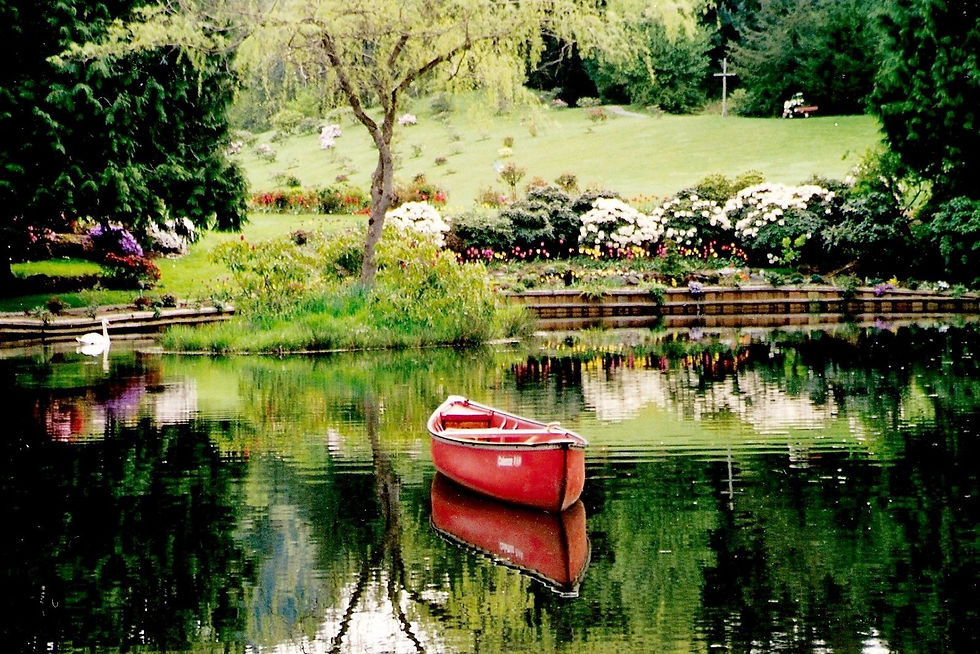
Stepping outside into the brilliant sunshine uncommon in the Pacific Northwest, I was drawn to a small wooden pier which extended out into a large pond lined with lily pads. No one else was there, and so I stretched out on the warm boards and felt my bones sink into the hard surface as the sun shone on my face. Taking deep breaths, I settled into my sacred place to await an encounter.


I took myself to The Pipeline on the North Shore of Oahu. It derives its name from the fact that if you sit on the sandy bluffs above the surfline, when winter swells come, a wall of water completely fills the horizon and moves as a single entity to crash on shore at the same time. When the swells reach 20 to 30 feet, which is what I pictured, the sound of this single wave hitting the shore is thunderous, and the sand shakes underneath your body.


In my imagination, I crested the hill slowly working my way through the warm sand, and stood and looked at the ocean before me. The cry of sea birds filled the salt air, wrapped in the smell of tropical blossoms. Gripping the sand between my toes, I watched the giant swells come ashore and began to try and picture God sitting next to me.


What would God look like?

I watched as a wave began to crest, its spindrift lifting into the air as it started to come ashore. Maybe I would picture Him as the powerful wave. But God was not the wave. The wave was created by Him, but it was not Him.


Not to be deterred, I tried to picture Jesus sitting in the sand next to me.


But I knew I did not want to picture a Jesus of European descent, all whitewashed and blue eyed and perfectly dressed with a halo on His head. He would have looked more like a Syrian refugee, and because my mind had been saturated with a North American picture of Him, it felt like betrayal to conjure up anything from my Eurocentric experience. So I remained in the sand with an empty place next to me, waiting to hear of my belovedness in God’s eyes.

I sat as the waves continued to pound and felt the weight of the empty place next to me in the sand. My last vestige of hope was The Holy Spirit.


What would the Holy Spirit look like?


I tried to conjure a vision of the Spirit’s presence to fill the empty space next to me. I thought of the saints who had been part of my journey and asked each to come sit next to me, but the memory of their love and care did not conjure their presence. After many failed attempts, I took a few more deep breaths to settle and open my heart. It was then that I heard a gentle voice speak into my heart.


Who do you need Me to be?


“I don’t’ know,” I answered as I continued to rotate images unsuccessfully into the empty space beside me in almost a desperate way.


Who do you need Me to be?


I don’t know.


All of a sudden I felt a Spirit presence come and sit next to me in the sand. For a few moments, I sat holding my breath soaking in the presence next to me, not wanting to lose this moment. Finally, I turned to see its face:


It was my 95 year old mom who had died several years earlier.


I felt her put her arm around my shoulders softly as she stared at the sea. We sat together that way in silence as wave after wave crashed on the shore. And then, without warning, she said quietly,


You are my beloved. In you I am well pleased.


Then I felt the Spirit’s presence gently leave us, and she just became my mom sitting beside me in the sand. How is it there? I asked. She turned her face to me, and her blue eyes were clear and filled with a light of joy.


It is so beautiful….It is so beautiful.


I wept.


We sat together wordless after that, as the shuttering thunder of waves meeting sand filled the air. I looked at her again, and I told her over and over again, “I miss you so much… I miss you so much…” She sat with a quiet radiant joy. The waves filled the horizon and came ashore. And I continued to weep.


But there was joy in that sorrow.


I had been given the gift of knowing she walked in beauty now, a place where I would one day hold her again and kiss her face. A place where every tear would be wiped away. She had journeyed to the Creator’s heart, and now rested on His eternal, distant shore.


But God had sent her to me, in that place of His undeniable presence, to speak to me of what I had not ever fully grasped in the deep reaches of my heart.

Until now.


I was His beloved.


Subscribe to the blog• Don’t miss out!

Thanks for subscribing!

  • Facebook
  • Twitter
  • LinkedIn
bottom of page